
Warehouses consume an enormous amount of energy. From lighting to heating to powering equipment, warehouses rely on energy consumption to maintain constant productivity. Energy bills are one of the highest expenses that a warehouse operation incurs.
Jump to Sections:
Making an effort to save on energy costs in the warehouse can help grow your bottom line, increase employee satisfaction and contribute to green initiatives. In this warehouse energy savings guide, we cover some of the unique energy challenges warehouses face and how to resolve them. We also look at some of the benefits of energy-saving equipment in the warehouse, including material handling solutions.
- The Importance of Energy Savings in Your Warehouse
- Top Energy Efficiency Challenges in Your Warehouse
- Top 10 Energy-Saving Warehouse Tips
- Energy-Saving Warehouse Equipment
- Shop Energy-Saving Equipment at Cherry’s Material Handling
The Importance of Energy Savings in Your Warehouse
Finding ways to save on your monthly energy bills can cut operating expenses and improve profitability. In addition to the obvious financial reasons to control energy consumption, there are other concerns that warehouses might have when it comes to energy use. Many energy-saving solutions also help improve productivity, as well as the comfort of the warehouse environment.
Below are three important reasons to save energy in your warehouse:
- Reduce energy costs: Inefficient warehouses can cost significantly more to operate than ones that have installed energy-saving solutions. Power-draining systems, heat and cold loss, poor ventilation and inefficient lighting all cause energy bills to add up.
- Maintain productivity: Energy-efficient systems are much more productive. They’re better at distributing higher amounts of power, which can make equipment work more efficiently. This efficiency can also help extend equipment service life.
- Improve worker satisfaction: Energy-efficient work environments also have benefits for employee satisfaction. Working in an environment with high-efficiency lighting that has good ventilation, proper temperature control and efficient equipment all lead to a greater sense of satisfaction.
Top Energy Efficiency Challenges in Your Warehouse
Many warehouses experience challenges when it comes to making their buildings more energy-efficient. Because energy efficiency addresses many different facets of a building, it’s important to look at the warehouse as a whole. From a leaky building envelope to outdated HVAC technology to poor lighting design, there are many ways warehouses lose energy.
Below are some of the common barriers to warehouse energy efficiency.
Poor Building Insulation
Many older facilities have insufficient insulation within both exterior and interior walls, as well as within ceilings. Often, when an older building gets repurposed for a new type of warehousing operation, the existing insulation won’t be sufficient for the new purpose.
For example, cold storage facilities with inadequate insulation lose a significant amount of energy from interior walls that separate the cold areas from the rest of the facility. Poor insulation results in the refrigeration system working extra hard to maintain the correct temperature, driving up energy costs.
Another issue with poorly insulated buildings is that there may be gaps where insulation is missing or worn out. A lack of continuous insulation allows heat and cold to escape at these vulnerable points.
Inefficient Lighting
Energy audits routinely find that inefficient lighting design is a major contributor to avoidable energy costs in warehouses. Warehouses are massive spaces requiring numerous light fixtures to provide continuous lighting. Because of the sheer amount of lighting in a given warehouse, making upgrades to lighting design can be a huge challenge for businesses to overcome.
High-intensity discharge (HID) lights are still a commonly used lamp type in warehouses because their purchase cost is so low. Despite their attractive price tag, HIDs are inefficient for a few reasons:
- High rate of lumen depreciation
- Limited color temperature options
- Require an extended warm-up and cool-down time
- Cause power surges and interruptions to lighting
In addition to the lamp type, there’s also the concern of not taking advantage of smart lighting technology. While lighting sensors and analytics technology are accessible today, many businesses have yet to adopt these lighting control systems for better warehouse energy efficiency.
Open Dock Doors
Warehouses face a unique type of threat to energy efficiency that most other businesses don’t. Warehouse loading bays are a significant obstacle to energy efficiency because they provide a massive opportunity for heat and cold to exit and enter the building.
Some of the factors that cause garage doors to contribute to energy loss include:
- Worn out or missing dock and hinge seals or weather stripping.
- Incorrect R-value of the dock door material.
- Poor insulation within the nearby dock walls.
- Lack of or improperly installed air curtains.
In many cases, poor airtightness around dock bays is made worse by not following energy-efficiency best practices. Leaving dock doors open for extended periods or failing to maintain the dock door seals can exacerbate energy loss.
Top 10 Energy-Saving Warehouse Tips
If you’re wondering how to save on warehouse energy bills, a good place to start is by using an energy savings checklist. Energy Star, which is an initiative of the Environmental Protection Agency, provides a warehouse best practices checklist to help managers identify opportunities to cut energy costs.
By understanding the main energy challenges facing warehouses, managers can implement strategies, techniques and training plans to directly address some of the main causes of energy waste. Though many energy-saving warehouse tips require an initial investment to implement, the long-run savings in reduced energy bills and increased productivity are well worth it.
Here are some of the top recommended ways to save on energy costs in the warehouse.
1. Upgrade Insulation
Building insulation is a critical energy-savings solution that allows facilities to minimize heat or cold loss or gain. Different types of facilities have different insulation needs based on the products they house, as well as the local climate. Cold storage warehouses need insulation solutions that prevent not just cold loss through exterior walls, but also through partitions that divide up cold-storage sections of the building.
Proper insulation also leads to improved climate control by regulating humidity levels and airflow through the building envelope. The combination of insulation, sealing and weather-stripping provide a continuous vapor barrier and minimize heat gain.
Adequate building insulation with the appropriate R-value rating can also help your warehouse’s HVAC system work more efficiently, saving energy costs on air conditioning.

2. Take Advantage of Natural Light
Many newer warehouses have skylights or numerous large windows that allow natural light to enter. The combination of natural light with smart lighting can help reduce the amount that it costs to light a warehouse.
Relying on natural light entering the warehouse reduces your reliance on overhead lights, which you can adjust based on the amount of natural light available. Another popular way to take advantage of the sun is to install solar panels to generate energy to offset consumption from conventional power sources.
3. Make HVAC Updates
An inefficient HVAC system drains energy from warehouses. HVAC 一 heating, ventilation and air conditioning 一 systems are complex and involve many different parts. Having an HVAC contractor inspect your current system can help identify areas for improvement.
For example, properly sealed ductwork is essential to allowing airflow to pass without leaks. In cases where areas of the warehouse seem to be improperly heated or cooled, it could be as simple as replacing the ductwork so that it’s airtight.
Another component of HVAC systems that can impact energy efficiency is the air filter. Replacing air filters regularly prevents clogging that impedes airflow. It also helps improve indoor air quality when you have fresh air filters installed.
4. Improve Temperature Control
Modern HVAC systems are automated with temperature control settings that allow you to set a programmable thermostat to maintain a certain temperature in specific zones. These settings help to reduce energy waste and make your warehouse more efficient.
The ability to automate temperature control is a massive improvement, particularly in warehouses that don’t operate 24/7. During working hours, you can set the temperature at the desired value, while during overnight hours when no one is working, you can turn the HVAC system off, as there won’t be a need for heating or air conditioning.
5. Conserve Equipment Energy
Warehouse equipment can easily be powered off or put into an energy-saving mode when not in use. Leaving conveyor belts or other machines running when not in use is a waste of energy and can affect your bottom line. Help workers become more aware of the energy draw from the equipment they use so you can create a greener warehouse.
When you’re trying to save energy in the warehouse, every little bit helps to bring down power consumption. While computers and electronics aren’t always a huge energy draw compared to lighting and HVAC, they still consume power continuously. Putting computers and electronics into energy-saving mode when not in use and powering them off overnight and over the weekends is an easy, energy-conscious habit for staff to adopt.
6. Implement Flexible Scheduling
Warehouse managers can take advantage of nature’s seasonal fluctuations to schedule energy-efficient work hours. During the summer, a warehouse’s air conditioning system consumes a significant amount of energy. While you can’t eliminate this need altogether, you can schedule shifts to start later or earlier in the day to avoid running the AC at its highest level during the hottest time of day.
The opposite can be true during the winter when you can take advantage of the warmer temperatures mid-day and reduce energy consumption during this time.
7. Install LED Lighting
LED light bulbs are energy-efficient, long-lasting lamps that can make your warehouse greener by cutting power consumption. Compared to older lighting methods, such as metal halides or fluorescent bulbs, LEDs have a higher initial purchase cost, but their replacement rate is lower. Additionally, because LEDs have become more popular, their costs are slowly dropping, making them a more affordable option today than in the past.
LED bulbs are also compatible with modern smart lighting systems, including occupancy sensors that turn lights on or off depending on motion. Another option is a vacancy sensor, which shuts lights off after a certain period of inactivity.
8. Switch to High-Efficiency Doors and Windows
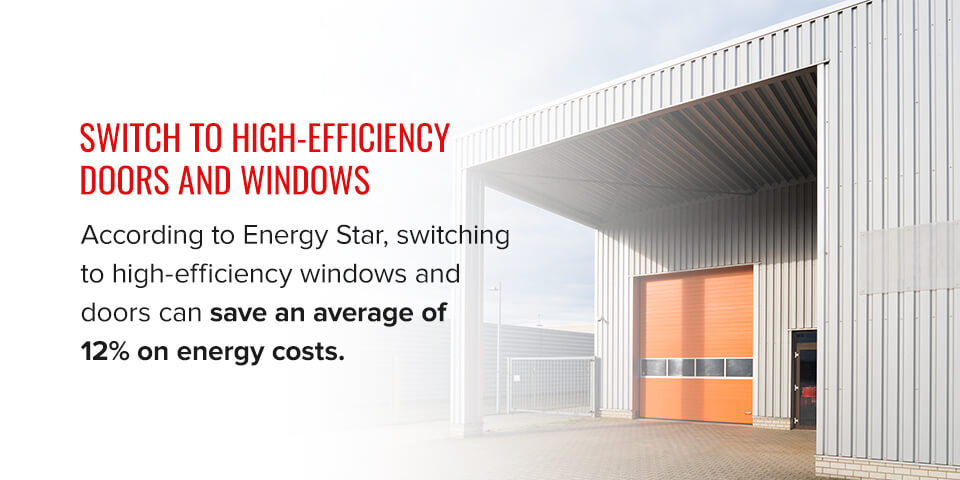
In addition to adding seals, weather stripping and insulation around doors and windows to improve airtightness, installing energy-efficient products is another important way to improve consumption. Older warehouses may still have single-pane windows, which were once standard. Today, energy-efficient double-pane windows trap air in between the two panes, which acts as an insulator.
Energy Star-certified windows, doors and skylights are rated for climate zones based on the climate and the type of insulation most needed. According to Energy Star, switching to high-efficiency windows and doors can save an average of 12% on energy costs.
9. Involve Employees
Involving employees in energy-saving initiatives will help business managers meet their green objectives. Consider providing training for employees that can educate them on best practices, particularly when it comes to equipment use and other behaviors.
Many companies also offer incentives to help promote the desire to reach energy-efficiency goals. You might also want to assemble a green team whose role is to find ways to save energy and lower consumption around the warehouse. All of these actions help create a culture of sustainability, eventually leading to reduced energy consumption for the entire company.
10. Invest in Energy-Efficient Equipment
If you’re finding your warehouse’s energy bills are too high, it could be time to consider upgrading your equipment to more efficient models. Newer equipment has advanced technology that requires less energy. Often, newer equipment is also more productive and has a longer service life, all of which contribute to energy savings.
For example, energy-efficient material handlers have high-efficiency motors that cause less energy waste. Additionally, choosing the right size of equipment for your needs ensures you’re using equipment with the right capacity for the most efficient job possible. With efficient equipment, you’ll process more orders in less time, which reduces energy bills and maximizes productivity.
Energy-Saving Warehouse Equipment
Energy-saving warehouse equipment is essential in today’s fast-paced warehouse environments. Modern material-handling equipment is designed to get more done while using less power, helping teams achieve their productivity and sustainability goals all at once.
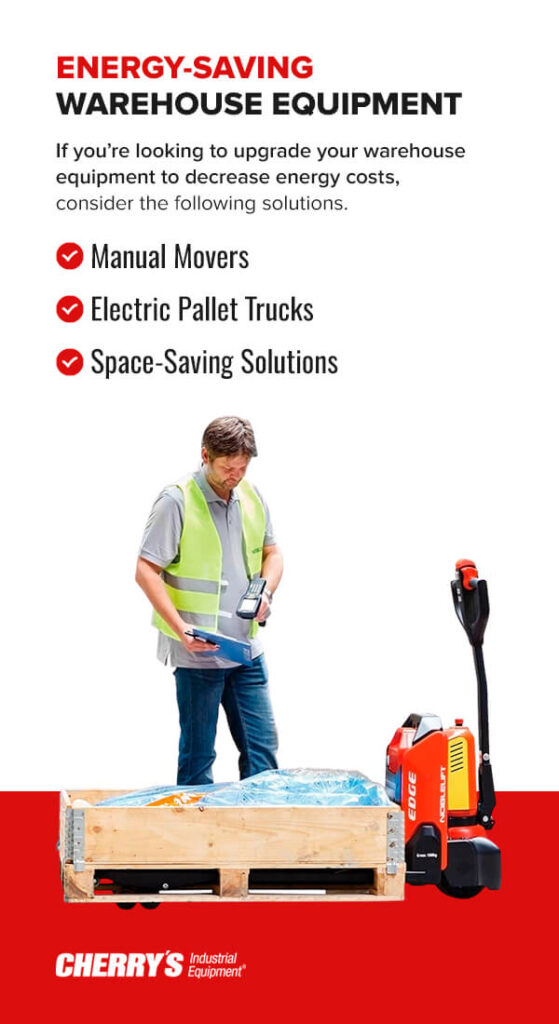
If you’re looking to upgrade your warehouse equipment to decrease energy costs, consider the following solutions.
Manual Movers
Manual movers, like pallet trucks, machine skates, roller skids, toe jacks and transport dollies, are low-cost and energy-saving warehouse equipment solutions. While nothing beats the convenience of powered lifts or pallet trucks, they aren’t the best solution in every scenario. Using a combination of powered and manual movers can help you cut back on electricity costs.
Have workers use manual movers for lighter loads and short-distance travel within the warehouse. Reserve powered trucks for more efficient uses, including heavier loads, farther travel and repetitive tasks. Manual movers are strong, durable and convenient energy-saving solutions that will also help improve safety and productivity.
Electric Pallet Trucks
Battery-powered pallet trucks are designed with energy-efficient motors that consume less power than alternative kinds. With rechargeable and long-lasting lithium-ion batteries, electric pallet trucks are the environmentally friendly material-handling solution your warehouse needs. Their ability to lift heavy loads will also improve your productivity, helping your team get more done in less time.
Electric pallet trucks also have additional ergonomic and health benefits. While gas-powered material handlers are loud and emit fumes, electric versions are quiet and fume-free, creating a cleaner and safer indoor environment.
Space-Saving Solutions
When investing in equipment to decrease energy costs, it’s important to look at your existing warehouse layout and how you can maximize it for reduced power consumption. Many warehouses aren’t designed to maximize space, leaving money on the table when it comes to energy bills.
With space-saving solutions like pallet racking, collapsible containers and bins and boxes, you can store more goods in less space. Space-saving solutions allow warehouses to either downsize their square-footage and save on operational costs or scale up their operations and maximize overhead costs.
Other eco-friendly solutions like stackable and reusable plastic pallets help warehouses cut back on their carbon footprint.

Shop Energy-Saving Equipment at Cherry’s Material Handling
Energy-saving equipment from Cherry’s Material Handling can help you achieve your energy-efficiency goals. With a wide selection of manual movers, electric pallet trucks and eco-friendly storage options, Cherry’s Material Handling is your source for improving energy efficiency in your warehouse.
Partner with us to help you develop a comprehensive energy-efficiency plan that will save money, improve productivity and optimize your workplace setting. Contact us today to learn more about implementing an energy-saving material handling equipment solution in your warehouse.