
Inventory management plays a bigger role in operations than many expect. Knowing how to overcome challenges in warehouse management could help you to retain customers, improve productivity and optimize warehouse efficiency. If you want to boost your customer base, start with an assessment of how you track and store inventory to see where you have room to improve.
Jump to Sections:
- Challenges Facing Warehouse Management
- Importance of Customer Retention
- Inventory Management Strategies for Customer Retention
- Equipment to Enhance Warehouse Inventory Challenges
- Find Solutions to Warehouse Management Problems at Cherry’s Material Handling
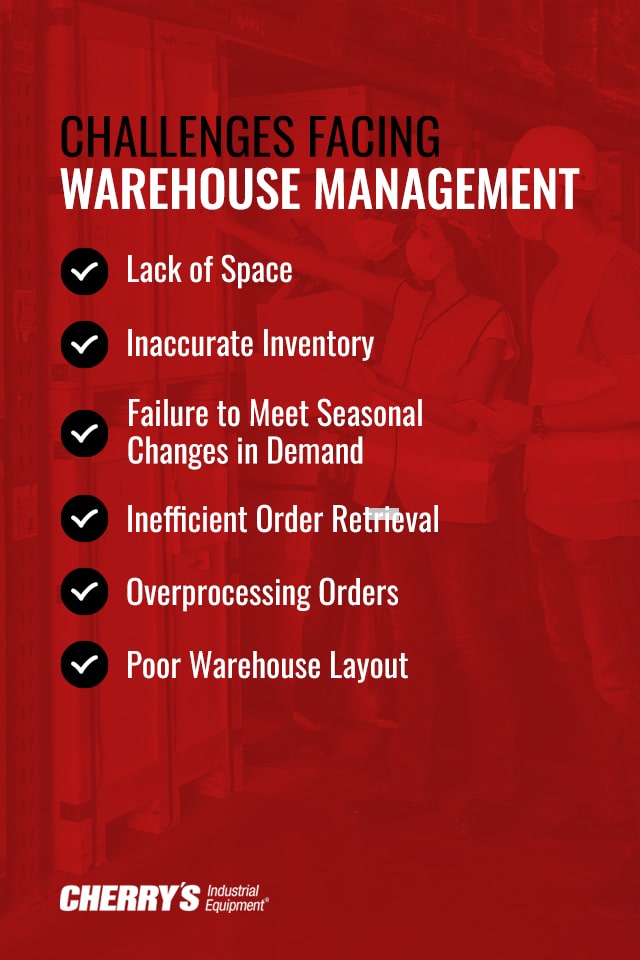
Challenges Facing Warehouse Management
Warehouses face many challenges you must overcome to ensure customer retention, efficiency, productivity and profitability. Evaluating your warehouse for these issues and addressing them will improve your operations quickly.
1. Lack of Space
Warehouse owners may complain of a lack of space, especially when they try to incorporate new or seasonal products onto the racks. But not having enough floor space is not always an issue when you know how to make the most of it. Think of using vertical storage instead to improve the volume of goods you can store per square foot of your warehouse.
2. Inaccurate Inventory
Inaccuracies in inventory cause serious headaches for customers and warehouse owners. No worker wants to go to pick a product only to find it not on the shelf. There are several reasons that inventories could be inaccurate. The workers may not use a system that updates as they pick products. Or existing products may get restocked in the wrong location.
Improving warehouse management methods with electronic tracking software coupled with RFID tags on the inventory could help solve these issues because you will always know where products are at all times.
3. Failure to Meet Seasonal Changes in Demand
Not being able to have enough stocked for seasonal changes in demand can cost you customers. For instance, if you don’t have enough stock of swimsuits as spring winds down, you could find yourself losing business because your supply does not meet demand. Improve your planning to avoid this type of issue.
A warehouse should have space allotted for current and next season offerings. Plus, don’t forget those customers who want to purchase goods out of season. You may want to maintain a small stock for those items, too, to retain their business.
4. Inefficient Order Retrieval
Not getting orders efficiently wastes time and increases the length of time customers must wait for their products. In some cases, you may fail to meet shipping promises to your customers. Not getting products to customers on time could lead to them doing business elsewhere in the future.
5. Overprocessing Orders
Just as workers taking too much time to retrieve orders can harm turnaround time, so can overprocessing orders. While you want to keep track of your inventory, you should not have redundant tracking systems. Scanning items or marking them off a list multiple times adds confusion and steps to the picking, packing and shipping process. Over time, the extra processing adds up to increase your total shipping time.
6. Poor Warehouse Layout
Poor warehouse layout means pickers may need to take more steps across your warehouse than necessary to pull orders. Extra steps mean wasted time and more fatigued workers. Additionally, you may have wasted space in your warehouse if you do not optimize the layout.

Importance of Customer Retention
Advertising focuses on getting new customers to do business with your company, though it can have as low as a 5% to 20% success rate of getting new people to buy from you. But current customers have a 70% chance of shopping with you again.
Once they spend money on your products, it is up to your customer service and quality of goods to keep existing customers. Keeping customers over time builds a loyal base of those whom your business can rely on for making sales. When customers are happy with your operations, they will recommend you to others, increasing the number of people you sell to.
What Is Customer Retention?
Customer retention refers to how many people return to your business to purchase products. Repeat customers are crucial to your company. You don’t have to work as hard on marketing to keep existing customers, but you must still put effort into customer service, appealing costs and product quality to avoid driving the customers away.
How to Improve Customer Retention Rate
Retaining customers means improving your overall business operations to optimize customer service. Aspects of doing this include examining your pricing structure, your warehouse efficiency and how you deal with issues.
To ensure you improve your customer retention rate, focus on what makes people want to do business with your company in the first place. Have you recently increased prices? If so, you may have raised them too much and too quickly to keep customers happy.
Another change that could cost you customers is a loss of efficiency in your warehouse. Late orders, damaged products or orders you cannot fulfill will drive away existing customers, keeping them from returning. Moreover, they could create negative reviews for your business. You want to have a smoothly operating warehouse to avoid these inventory issues that cause customers to go elsewhere for business. Improving your warehouse management strategies can dramatically help you keep customers, especially if inventory issues are at the root of your dropping customer retention rates.
Lastly, evaluate how you manage issues that arise with your company. What do you do if a customer calls with a complaint? How you take care of problems can also impact your customer retention rate. Try to smooth over issues through diplomatic discussion. You may also want to compensate the customer to make up the time and money they lost. Take customer complaints seriously and find out how you can improve your business with the information.
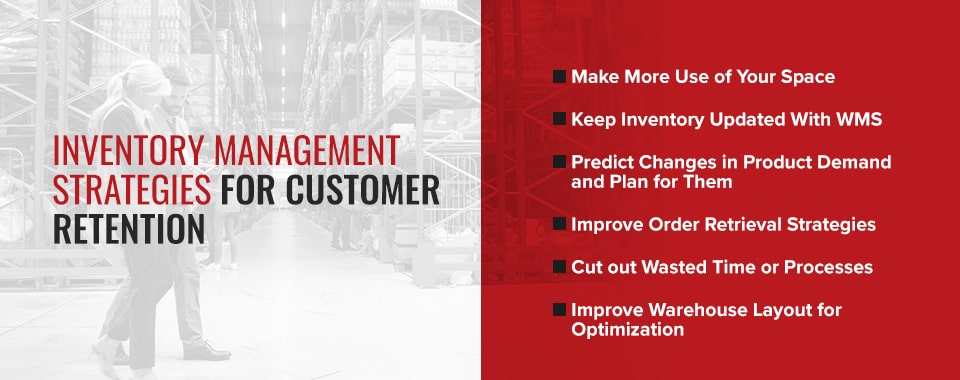
Inventory Management Strategies for Customer Retention
Because up to 65% of your sales will come from your current customers, you need to optimize your practices, including warehouse management, to retain as many as possible. Customer service should become paramount for your business’s practices because 67% of customers site bad experiences as reasons for not repurchasing from a business.
To keep customers, you want to ensure they stay happy from the moment they click on your website until they receive their order. Part of the customer experience and satisfaction stems from your inventory management. Make the most of your warehouse to keep it stocked with what your customers want so negative experiences happen only rarely.
1. Make More Use of Your Space
Even if you think your warehouse is too small, you’re not thinking in three dimensions. You can build up to use higher racks and shelves. When doing so, you will also want to upgrade retrieval equipment to reach those locations and ensure you secure tall racks appropriately. If you have higher shelves or racks, you have a space to store products that have low current demand. If they are seasonal, you can rotate the stock as the need arises.
2. Keep Inventory Updated With WMS
Maintain accurate inventory information by using a warehouse management system (WMS) that requires pickers to scan products as they pull them off the shelves for updates to the inventory. Some scanners connect to Wi-Fi to automatically update the inventory at each scan. Other models will connect to a computer at the end of the day to download the data changes.
The faster you can get the information updated in the system, the more accurate your inventory numbers will be. Accurate inventory numbers can prevent your customers from ordering something you don’t currently have in stock.
3. Predict Changes in Product Demand and Plan for Them
Create a calendar for moving seasonal products to more prominent locations in your warehouse to optimize retrieval during times of high demand. For instance, you can keep stock of winter holiday decorations in a distant corner until the fall. Then, you will want to move the stock closer to the shipping dock to reduce time for workers to get products.
4. Improve Order Retrieval Strategies
Make order retrieval as fast and simple as possible for workers. They need to know the layout of the warehouse, and you should also make sure the warehouse has a clear order for products and labels to indicate where things are. You may even consider integrating a WMS with tablets that your workers use to locate the product within the warehouse during retrieval to make their jobs more efficient.
5. Cut out Wasted Time or Processes
Skip paper documents for picking products. These waste time because the product and its paperwork go through multiple hands and stages before shipping. Instead, give workers a barcode scanner or tablet to scan orders as they pull them to ensure accuracy and keep the WMS inventory information updated.
6. Improve Warehouse Layout for Optimization
Lastly, make your warehouse easy to move around for both people and vehicles. Separate foot traffic and vehicular traffic with designated lanes to prevent accidents and keep people moving. Also, stock in-demand products closer to the shipping dock where workers can quickly pull them without needing to go to the back of the warehouse each time. You can get orders shipped out quickly and accurately, which is sure to impress customers.
Equipment to Enhance Warehouse Inventory Challenges
Customer retention could hinge on how you face the most common challenges of warehouse management systems. But knowing what to do is only one aspect of improving warehouse management to retain customers. You also need the right equipment to make your ideas work.
Pallet Racking
Increase the space you can use in your warehouse by building storage upward. Storing pallets higher up on racking frees floor space and optimizes the available area you use. When building upward, make sure to invest in sturdy pallet racks that will support higher weights than the loads you will put on them. This overage in capacity ensures the safety of workers and products.
Decking
If you already have pallet racks, increase the use you get from them by converting them to shelves for boxes or individual product storage. Placing decking over pallet racks easily changes the arrangement of your storage options in your warehouse without significant effort or time. Wire decking comes in many formats, including some types that prevent products from falling off the decks or fit more securely in place on the racks.
Pallet Stackers
Speed up your pallet stacking with fully electric pallet stackers. These models can enhance warehouse operations by moving products faster for quicker stocking or shipping. Additionally, you can move loads to greater heights for easier stacking on taller pallet racks.
Collapsible Plastic Bulk Bins
Keeping bulk bins with highly popular products closer to the packaging and shipping areas of your warehouse greatly reduces the time required for pulling products. The benefit of collapsible plastic bulk bins is the ability to fold them away when not in use. These provide you with a solution for getting highly demanded seasonal items closer to your workers when needed. During the off-season, you can store the products further back in the warehouse and collapse the bins until you need them next.
Safety Tape and Signs
Part of having a well-organized warehouse is ensuring everyone knows where to go and how to get where they are going. Using safety tape to create aisles for vehicle and foot traffic helps protect all workers from accidents that can cause delays. Safety tape can help organize warehouse arrangements to indicate aisles for stocking racks and for pulling products, as well.
Signs are also critical in maintaining a safe warehouse and improving operations. The signs you install can include safety signs indicating first aid locations or exits. Other types of signs prohibit wrong-way movement down single-direction aisles. You can also create signs that indicate where you store products in your warehouse to help workers to find what they need.
Work Positioners
Reduce worker fatigue to help them operate more efficiently by investing in work positioners. With capacities ranging from 2,200 to 3,000 pounds, these positioners do not lift as much as pallet stackers or forklifts, but they work well in tight spaces and bring pallets to a more comfortable working level. That’s ideal for workers who need to depalletize products during shelving. They also work well when moving bulk orders from one end of the warehouse to another.
Lift Tables
Move products higher in your facility with lift tables that can carry anywhere between 200 and 30,000 pounds. These tables make reaching the taller racks or shelves you install possible for workers who need to move products from a pallet to a shelf safely. The high capacity of lift tables ensures whatever you have on them can rest on a sturdy, stable surface.
Find Solutions to Warehouse Management Problems at Cherry’s Material Handling
You will find all the solutions you need for meeting the biggest WMS challenges at Cherry’s Material Handling. Browse our equipment options to find the right components you need to optimize warehouse layout, inventory management and efficiency. With a smoothly running warehouse, you can improve customer retention by meeting deadlines easier and avoiding issues with inaccurate inventories. A better warehouse starts here at Cherry’s Material Handling. Reach out to us online or call 877-350-2729 to learn more.