
As a warehouse manager, you direct inventory and equipment around your facility daily. Besides the bulky inventory traveling from receiving to storage to shipment, you also have a great deal of industrial furniture. Storage cabinets and workstations may occasionally or frequently need to relocate to maintain efficiency in your bustling warehouse.
Moving furniture is a challenging task. Many warehouse operators seek information on how to improve efficiency in the warehouse while relocating heavy objects. Cherry’s Material Handling has created this guide to help you find answers.
Jump to Sections:
- Challenges of Moving Heavy Items
- Equipment to Help Move Furniture and Heavy Items
- Types of Furniture Movers
- Benefits of Hydraulic Furniture Movers
- Shop Furniture Movers and Other Rigging Equipment From Cherry’s Material Handling
Challenges of Moving Heavy Items
When deciding how to move furniture and other bulky items, first consider the many challenges you could face, including:
1. Causing Property Damage
Moving furniture and other heavy objects by hand always leaves the risk of damage to the floor. A sudden drop can break tile or concrete and dent hardwood floors. Any dragging can scratch up floors and ruin their finish. It’s harder to keep furniture steady and off the ground when lifting it by hand, making floor damage more likely.
Even using the wrong type of moving equipment can scratch up floors that need special care. Another challenge is the added weight of the moving equipment. Using heavy-weight equipment to carry a heavy object can place a considerable strain on your floor, possibly even exceeding its loading capacity. Moving heavy items without considering your floor’s performance capabilities could damage its structural integrity.
Besides damaging the floor, you also risk harming the object itself. Dropping a heavy machine or piece of furniture is bound to leave a dent, crack or some other form of irreparable damage.
2. Facing Ergonomic Injuries and Safety Hazards
Many heavy objects are just too heavy for human hands, especially with industrial equipment. Anything heavier than the average adult is not a practical one-person moving job. While you might think you can get around this by using a team of employees, it’s simply not safe.
Even heavy objects within the capability of an employee or small group of workers can cause safety concerns. Strain during lifting and lowering is one of the leading causes of workplace injury. The manufacturing industry saw 11,090 injuries related to overexertion in lifting and lowering in 2019. The warehousing and transportation industry saw another 12,920 incidents of the same nature.
Musculoskeletal injuries, such as back strains, shoulder pain and muscle fatigue, are possible even when lifting lightweight objects. The stress on the muscles, discs and vertebrae grows as the weight increases, creating an even higher chance for injury.
Ergonomic injuries can turn into a major concern for warehouses and manufacturing facilities. The median number of missed workdays related to overexertion in lifting and lowering was 13 days in 2019. Besides ergonomic injuries, you can also risk workers dropping heavy objects on their toes or crushing their appendages. Any injury lowers productivity and may also impact employee morale. Plus, you may be responsible for workers’ compensation claims and other injury-related costs.
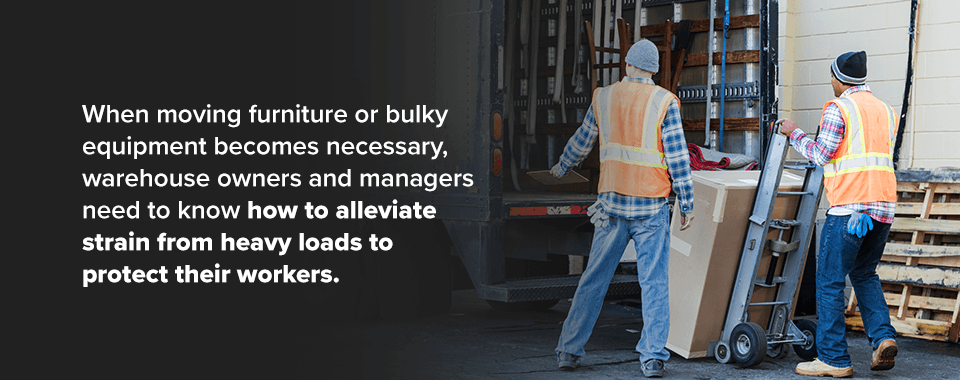
When moving furniture or bulky equipment becomes necessary, warehouse owners and managers need to know how to alleviate strain from heavy loads to protect their workers.
3. Maneuvering Tight Spaces
When moving heavy machinery or furniture, you’re not usually doing it in an empty room. You must steer clear of fixed objects, other furniture, permanent equipment and racks. When planning to move bulky furniture, consider the item’s dimensions. Plot the best route from point A to point B. Account for doorways, lifted heights and your moving equipment’s dimensions. If you’re moving a bulky object into a truck, choose a vehicle with the capacity to hold the furniture.
4. Choosing the Best Method for Transport
Warehouses have many choices when moving furniture and appliances, inventory or machinery. The right equipment for a particular job depends on the size, weight and shape of the object and the facility conditions. If you’re moving furniture onto a transport truck, consider the truck’s load capacity. Also, weigh the ease of loading the items onto the vehicle.
Equipment to Help Move Furniture and Heavy Items
Cherry’s Material Handling offers some unique solutions to help your facility move industrial furniture, bulky inventory, shipping containers and heavy machinery.

RNR-Series Furniture Movers
In most cases, the easiest and most versatile option for moving furniture and appliances is a specialized hydraulic furniture mover, also known as a hydraulic moving dolly. Other moving equipment works for the many different types of bulky objects that need transport through industrial facilities. Furniture movers are designed for your particular application. They’re ideal for transporting furniture, appliances, machinery, equipment, containers, safes and other bulky objects.
What exactly is a furniture mover? Furniture movers look a bit like hand trucks, except they can both lift and move bulky objects. They come in pairs to grip heavy objects from both sides and keep items level above the ground. The RNR-series furniture movers come equipped with heavy-duty, adjustable forks to support even the most massive objects. On the top, they include pads to protect furniture and machinery from scratches. They also have hook connectors to attach load-binding straps for added security.
One primary benefit of the RNR furniture movers is their hand-operated hydraulic pump. Once the forks are under the object, the two operators pump the jacks to lift the load above the floor. These jacks eliminate manual lifting, saving your workers time and muscle straining. Teaching your team how to move warehouse furniture with a hydraulic moving dolly is simple. Once the furniture is up off the ground, the swivel casters allow the two workers to wheel the load wherever it needs to go. The RNR series movers have load capacities ranging from 2,000 to 10,000 pounds.
Other Equipment for Moving Machinery in the Warehouse
Not sure if a hydraulic moving dolly is the right piece of equipment for the job? Warehouses have many material handling needs besides furniture. Knowing how to move heavy items of all stripes may require various specialized moving equipment, including:
- Machinery skates: Machinery skates are versatile movers for furniture and heavy machinery alike. They consist of a flat, textured surface and a set of nylon or steel rollers. Using a forklift, jack or another means of lifting, operators slowly set the object atop the machinery skates, usually one on each corner. The heavy objects can then be wheeled to wherever they need to be. Cherry’s offers many models to choose from, with up to a 24-ton lifting capacity.
- Roller skids: Similar to machinery skates, roller skids have a few features to make them more versatile. First, they have multiple styles of rollers. They may feature polyurethane for floors that need extra care and steel for cement and steel surfaces. They can also come with chain rollers for moving heavy loads over rough or uneven terrain. They have 360-degree swiveling pads, letting you steer your loads in multiple directions.
- Toe jacks: A useful tool for lifting equipment is the toe jack. These jacks easily lift your machinery or heavy furniture onto skids, skates and dollies. They’re both economical and essential when forklift trucks or hoists are not available.
- Transport dollies: With a load capacity of up to 80,000 pounds, transport dollies are an excellent option for moving heavy-duty equipment and industrial furniture around your facility. They come in many varieties, including individual, tandem and steerable for many applications.
Types of Furniture Movers
Furniture movers are distinct from other types of heavy equipment movers because they come as a pair. Two main types of furniture movers are available — hydraulic and manual. The hydraulic variety is preferred by professional movers and warehouse facilities that need to lift bulky, heavy objects regularly.
Hydraulic Furniture Movers
A hydraulic furniture mover is essential for heavier objects. The hydraulic power allows the operators to safely lift objects much heavier than their strength allows. It is the preferred choice for professionally transporting bulky items like furniture and machinery.
It’s essential to clarify that a hydraulic furniture mover still requires manual operation. It can be easily confused for a manual furniture mover because it features a hand-operated hydraulic jack. The difference is that a hydraulic mover doesn’t require manual strength. Once the hydraulic lifts have done their job, the two operators can wheel the object around using push handles.
Manual Furniture Movers
While not ideal for industrial settings, a manual furniture mover is a hand-operated version of a professional furniture mover. It has the same basic configuration, with the two movers working as a unit to lift an object evenly from both ends. Instead of pumping a hydraulic jack, the operator turns a manual hand crank. It won’t have the same lifting power as a hydraulic lift and is better suited for small moving companies than a busy warehouse.
Benefits of Hydraulic Furniture Movers
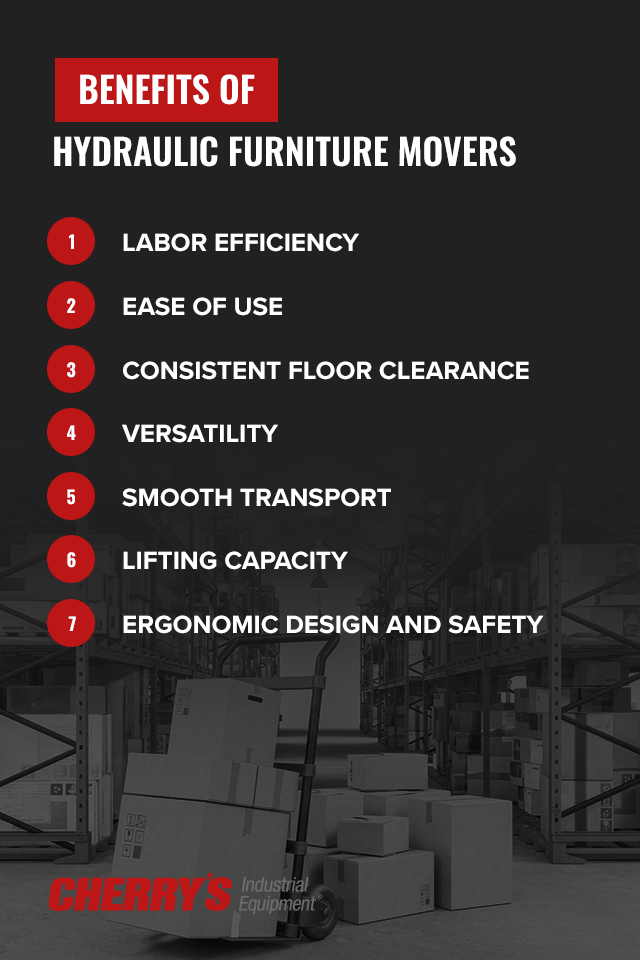
If you’ve ever helped a friend move or had to rearrange the furniture in your own home, you already know how beneficial a hydraulic furniture mover can be. In a warehouse setting, they can transport the heavy objects that keep your facility up and running, reduce your labor needs and provide a host of other benefits. The top seven advantages of hydraulic furniture movers are:
1. Labor Efficiency
Wondering how to improve warehouse efficiency? Replacing manual tasks with ergonomic machinery is an excellent way to accomplish this across your facility, and furniture movers are no exception.
A hydraulic furniture mover can turn a complicated moving project requiring a small team into a two-person job. Furniture movers are vital, labor-saving equipment for the warehouse. Moving furniture or bulky containers around your warehouse no longer takes the careful coordination of your team. Instead, more of your staff is freed up to perform other tasks. Already, the labor efficiency boost is evident.
Besides reducing the number of employees it takes to move bulky equipment, it also improves labor efficiency by streamlining moving heavy items. Lifting items manually takes a lot of strength. Hauling a massive refrigerator or safe across a long distance is slow work and will require your movers to take frequent breaks. Each time, they must slowly set the object down to avoid muscle strain and damage to the property.
With a hydraulic lift, the furniture is easily lifted off the ground with a few pumps of the hand jack. Once the item is suspended, moving it around is as simple as pushing a shopping cart. Your operators can wheel it around over a long distance much faster than they could by hand.
2. Ease of Use
Without the proper equipment, moving furniture or heavy machinery is a dreaded task. Hydraulic furniture movers have several features to make moving heavy objects feel effortless, such as:
- Hooks for load binders: The RNR-series hydraulic furniture movers feature both e-track and delta ring connections. They allow movers to secure heavy, irregularly shaped items with a load binder.
- Hydraulic hand jack: The hydraulic hand jack makes it easy to lift and lower heavy objects, with no straining involved.
- Steel swivel rollers: Once the furniture is in position, the swivel casters make transportation simple. They swivel in many directions to create a high degree of maneuverability. In a bustling warehouse, they make it easy to glide through doorways and aisles.
3. Consistent Floor Clearance
One challenge that comes with moving furniture and heavy objects by hand is that it’s much harder to keep things level. Human error might cause a corner to nick the floor or the side of a doorway. Pivoting around obstacles in tight spaces is a particular concern for manual movers. Since furniture movers lift furniture from both ends, the object has level clearance, even when turning corners or moving around obstacles.
This can be especially beneficial when moving machinery. Keeping the equipment level during transport prevents parts from falling off or getting rattled around inside the machine. It also prevents fluids from leaking.
4. Versatility
Since hydraulic furniture movers come in pairs, they can accommodate many dimensions. In theory, they can roll as far part as needed to lift extra-wide or extra-long objects. Our lowest-capacity model can lift up to 2,000 pounds, and our highest-capacity version can lift 10,000 pounds. Meanwhile, load securing straps allow them to accommodate many objects, including irregular shapes, which are challenging to grip by hand.
The adjustable forks can move close together or far apart to lift many different sized objects. For example, our best sellers, the RNR-4 Furniture Movers, have forks that come as close as 5 inches apart and as wide as 19.5 inches.
Because of their versatility, furniture movers have many applications in industrial settings. The numerous uses for a furniture mover include transporting:
- Shipping containers, crates and corrugated boxes to and from the loading bay.
- Appliance inventory, such as washers and dryers, refrigerators, dishwashers, heating and air conditioning units, water heaters and ovens.
- Furniture for industrial and commercial offices, including desks, workbenches, chairs and cubicles.
- Industrial cabinets and cabinet-shaped loads, such as safes and industrial control panels.
- Specialty industry equipment, including large printing presses, medical machinery and industrial ovens or kilns.
5. Smooth Transport
Hydraulic furniture mover sets come with two steel swivel casters per side. Thanks to these wheels, the furniture movers can be safely brought to a halt or turned to weave around the warehouse’s obstacles. Once the furniture is in position, the operators can spin it a full 360 degrees and push it back and forth or in any direction. The result is effortless maneuverability and a smooth ride from point A to point B.
6. Lifting Capacity
A hydraulic furniture mover doesn’t rely on human strength. As a result, it can quickly and efficiently lift some of the heaviest equipment and furniture in your warehouse. Other types of movers require a separate toe jack or forklift to raise and lower the machine or furniture into place. With a hydraulic furniture mover, the lifting capacity is built in. You don’t need to invest in a separate jack, and you can use your forklifts for other tasks throughout the warehouse.
7. Ergonomic Design and Safety
Your workers will appreciate that a hydraulic furniture dolly lowers the chance of back injuries. Heavy lifting is nobody’s favorite task outside of the gym, and a hydraulic lift’s ergonomic design prevents repetitive motion and overexertion injuries. There’s no chance your workers will accidentally lift from an awkward position or lift more than they’re strong enough to handle. They also won’t drop heavy objects during transport, increasing safety all around.

Shop Furniture Movers and Other Rigging Equipment From Cherry’s Material Handling
Are hydraulic furniture movers right for your facility? If so, browse our current inventory of furniture movers to find one with the capacity you need. We offer competitive pricing in quantities that make sense for your facility’s needs. Plus, we eliminate the bulky equipment catalogs and make it easy to buy your equipment entirely online.
If you need to speak with an expert, our knowledgeable product specialists will work to understand your facility’s unique needs and walk you through the selection process. Shop for Cherry’s Material Handling hydraulic furniture movers today, and call us anytime at 877-350-2729.