
Visuals are a powerful tool for communicating information. According to research, 65% of people are visual learners, and 83% of what we learn is from our sense of sight. That’s why lean management principles focus on the idea of visual control and management.
Visual management is a concept making significant headway in the modern warehousing industry. This lean tool relies on visual communication to promote optimal operation in warehouses. But what does this mean for warehouses, and how much benefit does it provide? We’re here to answer these questions, explain types of lean management and provide visual management ideas.
Jump to Sections:
- What Is Visual Management in Warehouses?
- How Can Visual Management Impact Your Warehouse’s Performance?
- How to Implement Visual Management in Your Warehouse
- Solutions to Facilitate Visual Management Implementation
- Shop Online
What Is Visual Management in Warehouses?
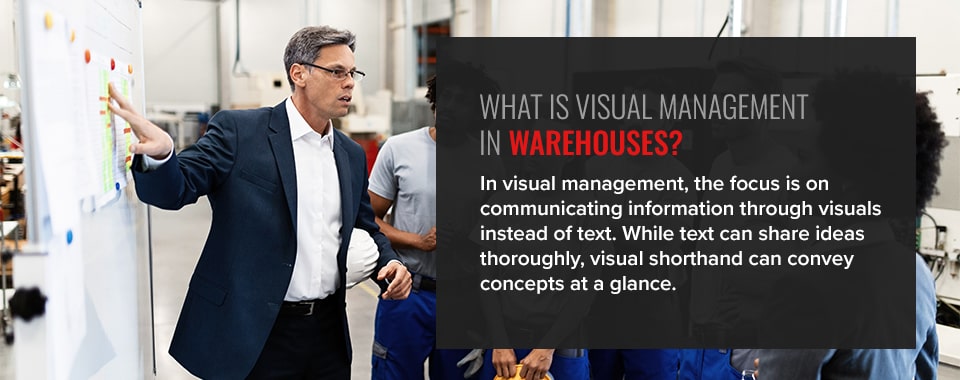
Visual management, also known as visual control, is a crucial lean management technique. In visual management, the focus is on communicating information through visuals instead of text. While text can share ideas thoroughly, visual shorthand can convey concepts at a glance. Visual management systems leverage this advantage to help employees understand processes and situations as quickly as possible.
What Is Lean Management for Warehouses?
Visual management is a valuable concept within the lean warehousing framework. What is lean warehousing? Originally developed by Toyota in the mid-20th century for automotive manufacturing, this concept aims to eliminate activities that use resources without adding value. Various concepts for specific industries focus on different lean principles and their applications, but all of them focus on streamlining operations.
What are lean principles in warehousing? In lean logistics, the 5S system applies five steps and concepts to the warehouse.
- Sort: The first step is to sort the warehouse, separating what you need from what you don’t. This inventory includes all equipment, instructions and other items in the work area. Remove any unnecessary items.
- Set in order: Next, systematically arrange all items, with defined places for each. This step includes placing appropriate signage, markings and labels around the warehouse to indicate where everything should go.
- Shine: Having sorted and arranged everything, the next step is to clean the workplace and replace or repair any damaged or broken items.
- Standardize: After cleaning the work area, managers should establish and communicate protocols for maintaining the facility’s arrangement and cleanliness. This step includes standardizing processes and procedures and making them visible and easy to understand for all employees.
- Sustain: The last step is to implement procedures to ensure workers maintain and improve processes. You’ll perform regular assessments to determine employees’ adherence to new lean protocols and identify opportunities for improvement.
Lean visual management is a crucial part of the “Set in Order” and “Standardize” steps, using visual cues to create defined places for tools and equipment and communicate processes within the warehouse.
Examples of Visual Management
While we’ve defined visual management on a surface level, that doesn’t paint a complete picture. What does this practice look like from a practical standpoint?
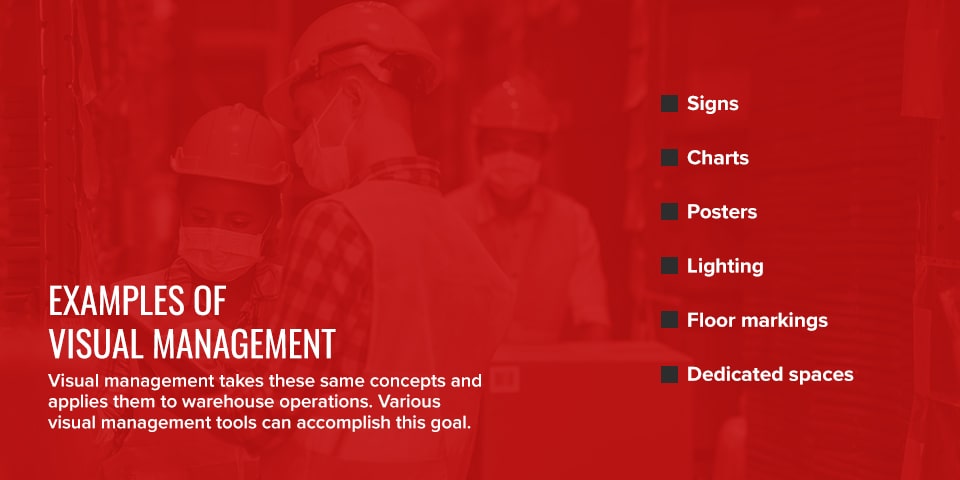
Almost everyone has encountered visual control in their daily life, especially on the road. Traffic lights, road markings and street signs are excellent examples of this phenomenon at work, communicating ideas through a combination of shapes, colors and instructions people can readily understand at a glance. Visual management takes these same concepts and applies them to warehouse operations. Various visual management tools can accomplish this goal.
- Signs: Visual signs are commonplace in warehouses, indicating hazards and requirements. Colors and shapes can communicate different concepts — for example, most people understand square red signs communicate fire-related dangers, while triangular yellow signs indicate hazards.
- Charts: Visual charts are another standard tool used in warehouses to indicate locations, chains of command and processes. For example, a warehouse organization chart can use color coding and icons to show the warehouse’s layout and organization, equipment and item locations and where specific processes occur.
- Posters: Posters are another typical visual management tool. Many warehouses post a summary of processes and rules on posters for clarification, so employees can see and review them. Doing so helps standardize processes and remove ambiguity.
- Lighting: Colored lighting is also a valuable tool. One everyday example is a traffic light — red means stop, yellow means yield and green means go. Similar lighting structures can also apply in warehouses to direct machinery traffic or communicate whether an area is safe to enter.
- Floor markings: Colored floor markings are another visual management tool often used in warehouses. These can indicate dedicated areas, pathways or placement for equipment within a warehouse.
- Dedicated spaces: Another example of visual control is having dedicated spaces for tools and equipment. For example, tool shadow tape creates silhouettes of specific tools, communicating their presence or absence. The same concept can apply to any equipment — having a dedicated space for each item indicates whether the equipment is available or currently in use.
When used across a warehouse and designed with a unified visual system, these practices can help quickly communicate processes and ideas, for streamlining workflows and promoting a safe working environment.
How Can Visual Management Impact Your Warehouse’s Performance?
Lean visual management presents an exciting idea for warehouse management and organization. However, any warehouse manager might wonder about the value of implementing this system.
Visual management offers a range of benefits for businesses, specifically warehouses.
- Improved safety: Visual management promotes a more organized, less cluttered workplace. Having a place for everything and clearly defined processes makes it much easier for workers to stay organized throughout the day. It also makes it easier to identify when something isn’t right, helping employees avoid workplace accidents and injuries.
- Increased quality: Visual management through also paves the way for standardized work. With clarified processes bolstered by visual cues, the warehouse can have smoother, more standard operations that help improve quality. Defined procedures also make it easier for employees to identify and report problems, preventing damaged products from shipping out.
- Employee engagement: Workers tend to take more active roles in workplaces with visual management, as they can more easily see and understand processes. When things are obviously out of order, workers can feel more comfortable taking ownership of the problem. Lean visual management also emphasizes employee feedback and ideas, making employees feel more involved in their workplace.
- Minimized downtime: Clarified processes with visual management tools also help workers use and maintain equipment properly. Signs with maintenance schedules ensure regular equipment service, while visual paths and directions instruct people on using warehouse machinery correctly. These factors keep machines in peak condition, minimizing lost productivity due to maintenance issues or accidents.
- Reduced waste: Standard processes and visual management help avoid lost products and wasted time through clear instructions. Machinery instructions and visual directions prevent accidents that can result in damaged products in warehouses. Guidelines and warehouse organization charts can help employees navigate the warehouse more quickly, reducing the time they need to get from point A to point B.
All these benefits lend to improved productivity and reduced costs in warehouses. However, to achieve this, facilities must take care to implement visual management properly.
How to Implement Visual Management in Your Warehouse
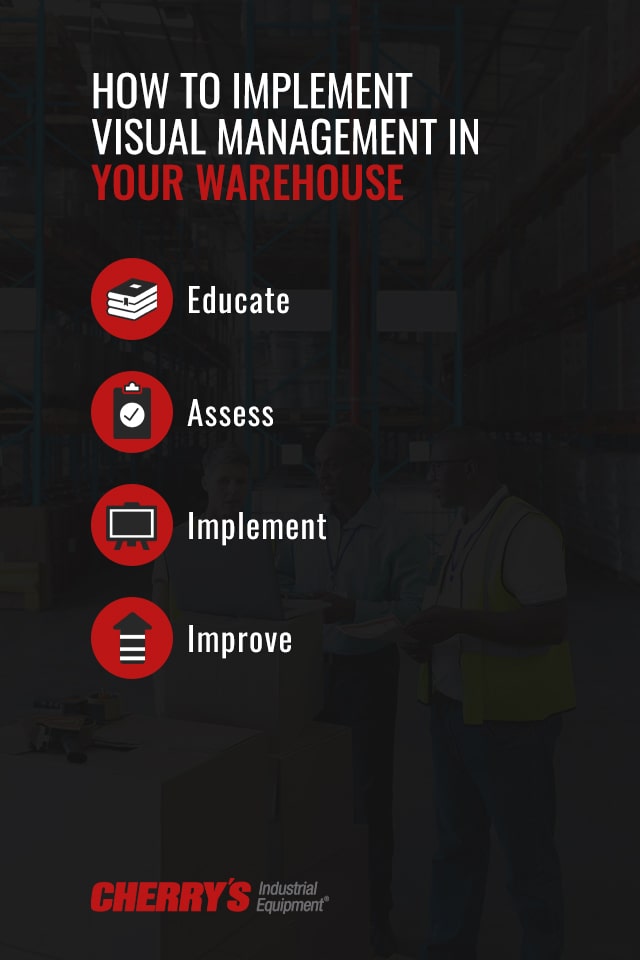
Given enough time, communication and the appropriate tools, lean visual management provides significant benefits to any warehouse. To start implementing visual management in your warehouse, here are four essential steps closely related to the lean 5S framework.
- Educate: Educating employees is the first step to successfully implementing lean inventory management tools. New processes can’t succeed if people do not recognize and follow them. Start with management and then work down to employees, explaining the goals and principles of visual management to get everyone on board with the project. This education should be continuous throughout the implementation process, updating people on standards and procedures as you go.
- Assess: Once everyone is on board, start assessing your workplace to identify opportunities for visual management. If you’re following the lean 5S protocol, this would be step 1, “Sort.” Identify redundancies and areas of confusion and come up with solutions using visual control tools. While designing the visual control system, there must be a unified, consistent, easy-to-understand language. During this process, involve employees to identify opportunities and receive feedback on the system before implementation.
- Implement: Once you have a design for your system, start implementing visual controls. If you’re following the 5S protocol, this would be steps 2 through 4. Try to do this methodically, implementing one control at a time and training staff as you go. For example, shadow boards have silhouettes of each tool’s correct place. If you choose to install shadow boards, add them all at once and educate employees on their purpose, use and expectations before moving onto the next visual control tool.
- Improve: Once you have all visual controls in place, the process doesn’t stop there. Continuously assess the use of visual control tools in your warehouse. In the 5S framework, this is step 5, “Sustain.” Monitor your visual control tools to determine how well they are working, whether employees are using them and where you can make further improvements.
Whether you are implementing lean visual management across your warehouse or in a few critical areas, these basic steps can get you started.
Solutions to Facilitate Visual Management Implementation
If you’re looking to implement visual management in your warehouse, Cherry’s Material Handling has solutions for you. Our 5S Visual Aids include:
- Floor signs: Our floor signs enable you to convey safety messages effectively. Our collection includes various pre-printed signs specifically for the warehouse industry, including safety equipment reminders, forklift driver directions, stop signs and directional signs. These signs are available in a range of sizes, shapes and colors to match your facility’s color-coding system. We create this signage with the warehouse industry in mind, designed to be sturdy enough to withstand demanding work environments. If our existing signs don’t meet your specifications, don’t worry — we can work with you to develop custom signs for your unique needs.
- Tool shadow tape: Are you looking to implement shadow boards to standardize tool and equipment placement? Cherry’s Material Handling can help with tool shadow tape. Use this tape to create silhouettes of each item. It adheres to a range of surfaces to meet your specific facility’s needs. By showing employees where to find items and put them back, you’ll eliminate clutter and create a safer, more productive work environment.
We also offer other safety and visual control tools, including aisle markings and marking tape and floor tape in a range of colors. We sell custom floor safety tape and sign options for your facility.

Shop Online
Lean visual control is a valuable tool for any warehouse, improving efficiency and reducing waste throughout your organization. Excellent visual management systems also promote communication, standardization and safety among employees, helping maximize productivity while minimizing workplace accidents. If you’re interested in implementing a visual management system in your warehouse, Cherry’s Material Handling is here to help.
We have a wide range of equipment specifically designed for warehouses and the material handling industry. With over 35 years of experience, we know the unique challenges of the material handling industry and can help pair you with solutions. On top of our standard equipment, we carry a wide selection of visual aids that align with lean principles. You can browse our high-quality, competitively priced selection easily through our user-friendly online platform. If you can’t find what you need, our trained product specialists will work with you to explore your options and develop solutions specifically tailored to your facility’s goals and requirements.
Learn more about Cherry’s Material Handling and our products today. Give us a call at 877-350-2729 to speak with a product specialist or contact us online using our form at your convenience.